PlayExplainer
Star Point explained: the 2026 scoring change U.S. coaches should teach
Two advantage cycles precede a deciding point. A practical guide to the sequence, return-side choice and the difference between game scoring and match format.

By X3Insights News, News desk
3 min read
If you started watching Premier Padel this year, a long game at deuce may have ended sooner than expected. The reason is Star Point, the scoring option introduced across several FIP circuits in 2026. It preserves two opportunities to finish a game through advantage before a single deciding point settles it.
For U.S. coaches, the challenge is both practical and tactical: players need to recognize which scoring system is being used, keep track of the deuce sequence and prepare for a decisive return without turning the lesson into a rules debate.
The sequence, without the confusion
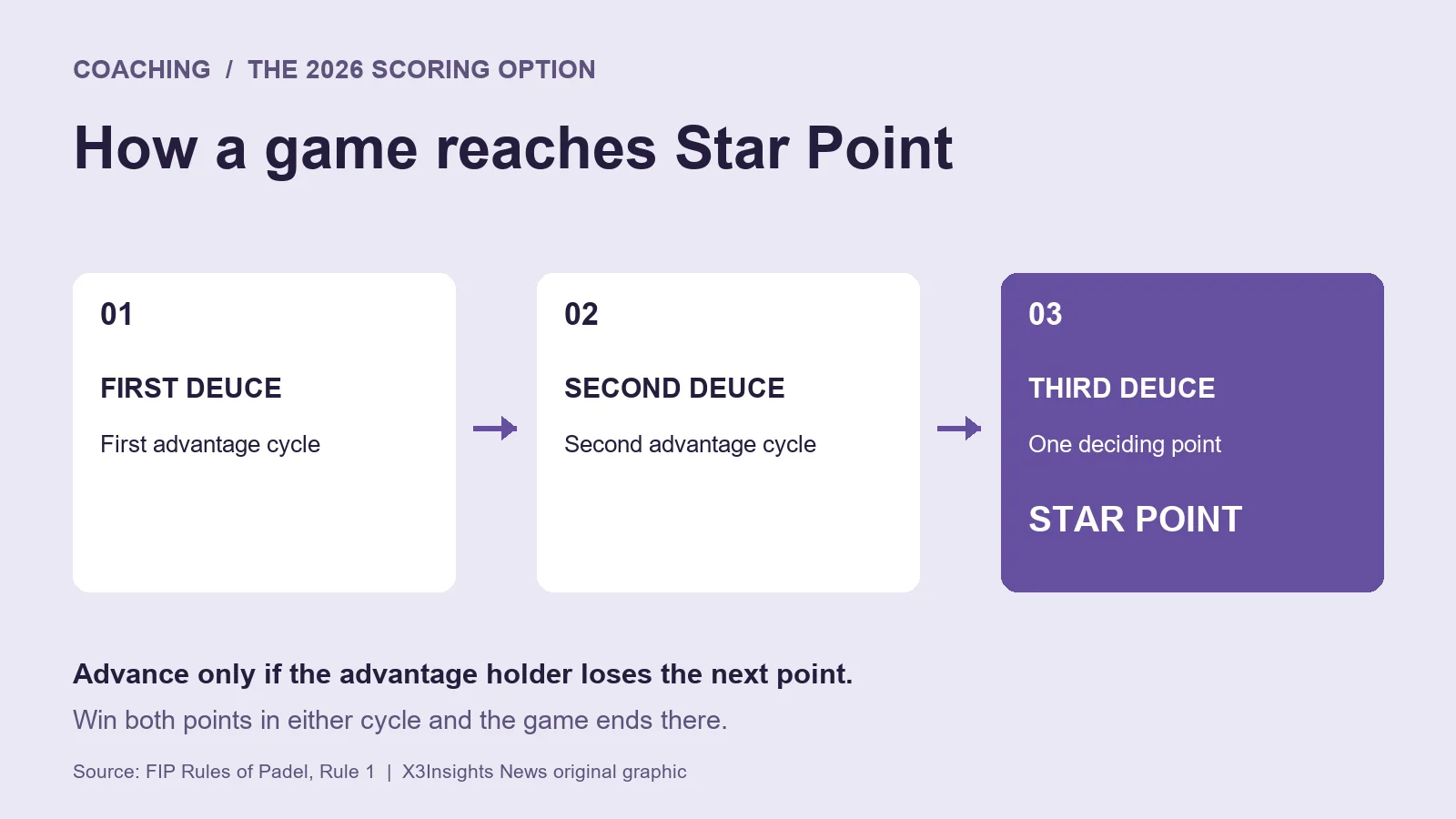
The FIP Rules of Padel, Rule 1, lists Star Point separately from conventional advantage scoring and Golden Point. Under Star Point:
- At 40–40, the game reaches the first deuce and then the first advantage.
- If the advantaged pair wins again, the game ends. If it loses, play returns to the second deuce.
- The next point creates the second advantage. Winning again ends the game; losing it brings the third deuce.
- A single Star Point now decides the game.
At that deciding point, the receiving pair chooses the right or left receiving side. The receivers cannot swap their established positions just to change who returns. In mixed matches, the receiver must be the same sex as the server.
The essential difference from Golden Point is the timing. Golden Point decides the game at the first deuce; Star Point allows two advantage cycles first. Conventional advantage scoring can continue through further deuces.
Why the tour changed
FIP's December 2025 announcement said the system was approved at its November 28 general assembly and would be introduced in 2026 across Premier Padel, the CUPRA FIP Tour, FIP Promises and FIP Beyond. Its rollout began with the CUPRA event in Melbourne before Premier Padel's Riyadh opener.
The federation and tour presented the change as a balance between retaining advantage play and making game length more manageable. Their calendar and scoring announcement also connected it to scheduling and player considerations. Those are stated objectives. They are not, on their own, measured evidence that every match is shorter or that players experience a particular physical benefit.
The rule does put a numerical boundary on a standard game. Reaching 40–40 takes six points; two unresolved advantage cycles add four; the deciding point adds one. The resulting maximum is 11 points. That is a calculation from the sequence, not a match-duration statistic: rallies, sets and tie-breaks still vary.